
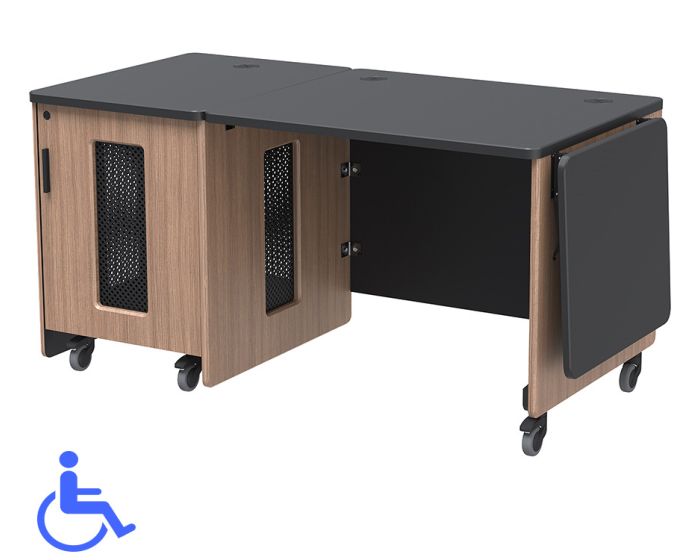
A desk is not just a flat surface for storing a computer anymore. In today’s workplaces, desks shape how people work, collaborate, learn, and interact with technology — and the wrong decision can surreptitiously sabotage all three.
A desk fit for the purpose takes into account everything from productivity to accessibility to adaptability, whether you’re designing a corporate office, training room, classroom, public-sector facility, or a hybrid workspace. A 12-month study funded by the American Society of Interior Designers (ASID) Foundation explored office workers’ experiences with adjustable-height desks and concluded that not only did 65 percent report increased productivity, but 47 percent reported a significant reduction in discomfort to their upper back, shoulders, or neck. The findings were published in the International Journal of Workplace Health Management.
This guide details what to consider in a commercial desk solution, how to align furniture with its surrounding environment, and which AVFI products are built specifically for optimum functionality in practical use cases.
Explore AVFI desk solutions: Explore AVFI Desk Solutions
Why Desk Selection Matters More Than Ever
Workplaces have changed dramatically. Technology is woven into nearly every task, teams flip-flop between solo and collaborative work, and organizations must cater to users with specific physical needs. Sedentary jobs have increased by 83 percent since 1950, according to the American Heart Association — a trend that makes careful selection of ergonomic furniture more pressing than ever.
A well-designed desk can:
- Create better ergonomics and minimize fatigue during the workday
- Reinforce technology and ensure cleaner cable management
- Enable multi-use environments such as training rooms and collaborative areas
- Provide ADA and accessibility accommodations for all users
- Optimise space without loss of use
In effect, desks have become workspace infrastructure, not simply furniture.
Key Features to Consider Before Choosing a Desk
Choosing the right desk begins with clarity about how the space will be used, who will use it, and what technology needs to be supported. Here are the six factors to consider:
1. Ergonomics and Adjustability
Fixed-height desks lead to long hours, resulting in musculoskeletal strain, attention challenges, and lowered productivity. Height-adjustable desks let users switch between sitting and standing, something research increasingly backs as a quantifiable driver of productivity.
Employees using sit-stand desks were up to 46 percent more productive than colleagues in seated-only workstations, according to a six-month study conducted by Texas A&M University’s Health Science Center School of Public Health. And a different peer-reviewed study found that participants working with height-adjustable desks self-reported a 17 percent drop in sitting time over three months — an effect that continued at the 12-month follow-up.
The adjustable desk is particularly helpful in:
- Offices that have shared workstations or hoteling workstations
- Extended sessions with training environments
- Education institutions
- Centers for accessibility
Example AVFI solution: ADA-Compliant Electric Lift Sit-Stand Desk
This desk supports inclusive design while providing ergonomic flexibility for all users.
2. Technology Integration
Modern desks need to accommodate monitors and CPUs, charging stations, and collaboration tools, while avoiding cable chaos. In tech-enabled workplaces, integrated cable routing and equipment storage have become non-negotiable — baseline functionality for a tidy professional environment.
Look for:
- Built-in cable routing channels
- Storage of equipment mounting options, and CPU
- Technical-grade, durable surface materials
- Space for all peripherals and computing hardware
Example AVFI solution: DS3048-LFT Computer Desk
Designed for technology-enabled environments, it supports computing needs while maintaining an organized footprint.
3. Flexibility and Reconfiguration
Modern spaces are expected to fulfill a variety of functions. A training room today could be a collaborative workshop tomorrow or even a testing lab next month. Modular desk systems let layouts change without having to replace furniture — a key benefit for organizations that are hosting larger or more fluid teams.
Ideal for:
- Learning hubs and corporate training centers
- Institutions of higher education and K-12
- Flexible meeting and event spaces
Example AVFI solution: Modular Folding Table System
This system enables quick reconfiguration, making it easier to adapt spaces to changing needs without replacing your entire furniture investment.
4. Accessibility and Inclusive Design
Accessibility is more than just a compliance requirement — it’s a key design principle. Raised desks also have the appropriate clearance, reach ranges, and general adjustability for seated users or those using mobility devices, so every participant can fully engage in discussions.
Accessible desks are essential in:
- Federal, state, and municipal government facilities
- Service environments for the public
- Institutions of learning from kindergarten through higher education
- Corporate workplaces with systems of inclusion
Example AVFI solution: DSL38 Desk
Built to accommodate a wide range of users while maintaining durability and professional appearance.
5. Durability for High-Use Environments
In shared or high-traffic environments, desks must endure constant and unpredictable usage across shifts and users. Material quality, structural integrity, and surface finish are all key factors in performance and service life. A desk designed for heavy use means less frequent replacements and lower total cost of ownership.
Durability is especially important in:
- Tech classrooms and computer training labs
- Government and public-sector installations
- Conference centers, event facilities
Example AVFI solution: Desk End for PD51 Series
Designed as part of larger systems, it enhances workspace continuity while maintaining structural reliability.
6. Multi-Functional Workspace Design
As organizations move towards collaborative and hybrid work models, desks have to facilitate both individual tasks and shared workflows. Multi-functional desks permit users to shift between activities — individual focus, small-group collaboration, or presentation mode — without having to move or reconfigure each time.
Look for:
- Larger surface areas for more than one user or task
- Power and data accessible equipment-ready configurations
- Flexible for solo or classroom use
- Expandable architecture that accommodates organizational needs
Example AVFI solution: Multi-Functional Desk
This design supports dynamic workstyles, combining flexibility with a professional aesthetic that suits modern shared environments.
Choosing the Right Desk Based on Environment
Desk solutions are not one-size-fits-all. Matching furniture to the actual way a space will be used enables usability, product longevity, and more purposeful environments.
Corporate Offices
Desk selection in corporate environments must accommodate ergonomic needs for workers who sit for long hours at workstations, support clean technology, and maintain professional aesthetics. Modern office arrangements will therefore be best catered to with sit-stand and computer-ready desks.
Training Rooms and Learning Environments
Training venues require furniture that allows structures to change quickly between instructor-led, group work, and individual testing formats. Reconfigurability and durability come in the top 2. Modular desk systems offer the most for this here, enabling an area to be reconfigured in minutes, not hours.
Government and Public Sector
Facilities open to the public need to be ADA-compliant, and they need to accommodate a variety of users, body types, and accessibility requirements. Adjustable and inclusive desks are not merely a luxury in those environments — they’re a compliance baseline, as well as an equity commitment.
Educational Institutions
Education needs desks across K-12 classrooms and the university learning hallways that facilitate individual work, group collaboration, lab instruction, and presentation. Selection should be dictated by mobility, technology readiness, and long-term durability. Multi-functional or modular desks tend to be the best fit.
Hybrid and Collaborative Workspaces
In hybrid environments, desks need to accommodate shared access to technology as well as rotating teams while quickly adapting to different meeting or work configurations. Both of these settings benefit from multi-functional desks that can scale with evolving workflows and provide the most operational flexibility.
Designing Workspaces That Support People and Technology
Choosing the right furniture has a mathematical correlation to how well people engage with their surroundings. An intentionally selected desk supports improved posture, easier tech integration, and a more flexible environment that can organically expand as your organization grows.
Instead of static fixtures, forward-thinking organizations see desks as a means to facilitate productivity, accessibility, and collaboration — investments that continue to pay dividends both in terms of employee well-being and operational efficiencies.
By matching desk selection to how a space is used in practice — not simply what looks good on a floor plan — you end up with environments that are more manageable, more comfortable to work in, and better configured for contemporary needs.
Explore AVFI Desk Solutions
Browse the full collection of professional desks designed for technology-enabled, accessible, and flexible environments: View all desks
Need help selecting the right desk for your specific space? Contact the AVFI team for personalized guidance.
Sources: International Journal of Workplace Health Management (2017); Texas A&M University Health Science Center, sit-stand productivity study (2016); American Heart Association, sedentary work trends data.