
Many people mistakenly believe that hybrid learning is merely a temporary adaptive solution spawned by the COVID-19 pandemic. In reality, it has become a permanent core feature of educational institutions' operations: a 2023 EDUCAUSE report shows that 73% of colleges and universities have adopted it as their standard instructional model, and hundreds of K-12 school districts have also expanded relevant programs to serve students with special needs.
Traditional on-campus physical classrooms were originally designed exclusively for in-person students attending classes on site, and were never built to simultaneously serve three groups of remote users: live-stream viewers, video call participants, and visitors accessing recorded content. Many institutions mistakenly assume that renovating these classrooms only requires upgrading audio and video hardware, but in reality, they must also adjust the placement, design, and configuration of furniture adapted to integrate with these relevant technologies.
This procurement guide, developed for the construction of hybrid classrooms at colleges and universities, covers the deployed configurations of classroom furniture adapted to support hybrid teaching, as well as supporting AVFI products that underpin synchronous dual-track instruction.
Explore AVFI solutions for hybrid classrooms: Explore AVFI Solutions for Hybrid Classrooms
The Furniture Problem in Hybrid Classrooms
Most current discussions of hybrid learning focus on technical elements such as cameras and software. While these technologies are indeed necessary, classroom furniture, an element often overlooked, directly impacts core teaching processes, including an instructor's standing position, access to equipment, audio pickup, and adjustment of teaching setups.
This paper outlines three adaptation flaws of physical hardware in hybrid teaching scenarios: fixed podiums force instructors to turn their backs on remote cameras, mobile carts that hold teaching equipment shake and undermine the stability of live class broadcasts, and multimedia stations lacking integrated cable management force instructors to become distracted, all of which impair teaching efficiency.
A 2022 survey released by the Babson Survey Research Group shows that faculty at colleges and universities identify the core barrier to effective hybrid teaching as the physical layout of classrooms. Standard single-seat classroom arrangements cannot adequately serve both in-person and online audiences, and classroom furniture is a core variable that can either exacerbate or resolve this problem.
What Hybrid-Ready Classroom Furniture Needs to Do
Effective hybrid classroom furniture must simultaneously fulfill 4 types of functions that traditional furniture does not need to undertake all at once.
This study proposes four core design rules for blended learning classrooms:
- All audio-visual devices, including laptops, external monitors, and other related equipment, are integrated into a unified operating console to eliminate messy cabling.
- Camera positions are arranged such that instructors do not need to turn around to simultaneously face both in-person audiences and the camera.
- Furniture is designed to be quickly reconfigurable to adapt to three types of teaching modes without disrupting pre-set audio-visual arrangements.
- The operating console is height-adjustable to accommodate all instructors who use the classroom.
Key Furniture Solutions for Hybrid Classrooms
Mobile Instructor Stations
The mobile teaching podium (or lectern), designed exclusively for hybrid classrooms, is the core, most versatile piece of furniture in the hybrid classroom settings. It can centrally store all types of instructional technology equipment, and its orientation can be adjusted to align with the live-streaming camera or to face teachers and students. When a class switches to group work mode, the podium can be moved completely out of the way to free up space.
The most efficient mobile workstation suited for hybrid work scenarios must be fully equipped with four core configurations. Its casters can be locked to support stationary fixed-location work, or unlocked to enable rapid relocation and deployment.
AVFI Solution: Mobile Instructor Station (PD51): A fully equipped mobile teaching station designed for classrooms and training rooms. Supports laptops, microphones, and AV peripherals while providing the mobility required for flexible hybrid room configurations.
Podiums and Lecterns with Rack Mount Capability
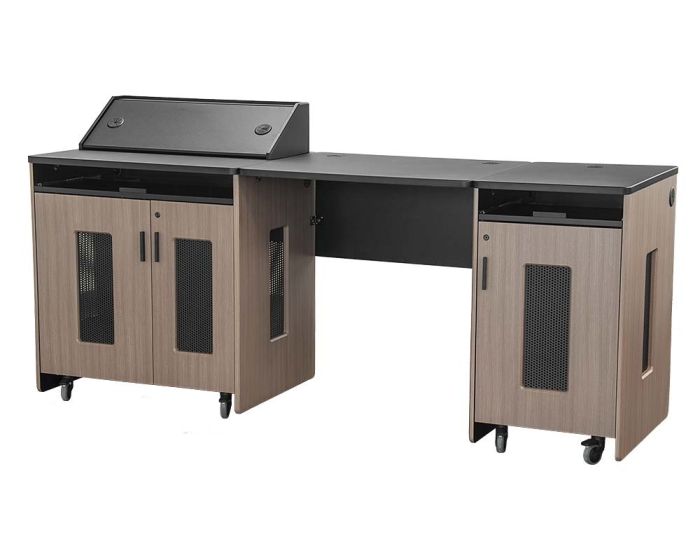
This study focuses on hybrid classrooms equipped with complex audio-visual systems, addresses the operational pain point that instructors must manage three types of professional hardware, including video conferencing codecs, and introduces a podium with rack mount capability. This podium can centrally deploy all relevant hardware, cutting the number of operating stations that instructors need to access when delivering live-streamed hybrid instruction.
The rack-mounted demonstration station can centrally house audio-visual processors, power amplifiers, and conference hardware. It enables orderly arrangement, thermal management, and safety protection, resolving the reliability problems of temporary device clusters in hybrid classrooms.
AVFI Solution: Podium with Rack Mount (PD5103): Designed for technology-intensive educational environments, this podium accommodates rack-mounted AV hardware at the instructor's position, supporting the complex equipment requirements of hybrid and broadcast classroom setups.
Multimedia Standing Desks
In hybrid learning scenarios, instructors must cater to both in-person and online audiences simultaneously, and often need to stand while teaching for extended periods. Height-adjustable multimedia podiums can provide ergonomic support, while also enabling convenient access to and organized management of all types of teaching equipment.
A 2016 study published in the International Journal of Environmental Research and Public Health indicates that sit-stand workstations can reduce fatigue and musculoskeletal discomfort among users performing standing work tasks, and can meet the work needs of lecturers teaching hybrid courses whose individual teaching sessions exceed the length of traditional class periods.
AVFI Solution: ModuDesk® Multimedia Standing Desk (DSL38): Height-adjustable, ADA-compliant, and designed for technology-enabled environments. Includes integrated wire management, ventilation, and equipment storage for hybrid teaching setups that require sustained, organized technology access.
Mobile AV Carts for Flexible Room Configurations
Not all hybrid teaching classrooms are equipped with a fixed instructor podium or lectern. In multi-functional teaching spaces that support multiple switchable layouts, mobile AV carts do not restrict instructors, and this solution delivers particularly prominent value in K-12 scenarios where multiple instructors use a single classroom.
It is advised that when the vast majority of educational institutions assess their AV cart procurement needs, they should prioritize verifying 3 core, individually verifiable standards: cable management, display mounting stability, and non-marking casters compatible with both hardwood and carpeted flooring.
AVFI Solution: Multimedia AV Cart (103324): Designed to support monitors, cameras, and AV equipment in flexible classroom environments. Provides the mobility needed for rooms that serve multiple instructors and formats throughout the day.
Mobile Telepresence Stands
As video conferencing has transformed from an occasional supplementary tool in educational settings to a routine daily configuration, dedicated telepresence stands have become standard classroom infrastructure. Cameras positioned at eye level support more natural interaction among participants across different spaces than those placed arbitrarily.
Mobile telepresence stands can be repositioned according to room layout, enabling various types of institutions to adapt to diverse classroom configurations and overcome the limitation of fixed cameras, which cannot cover the full range of all application scenarios.
AVFI Solution: Mobile Telepresence Stand (TP1000 Series): Purpose-built for video conferencing and hybrid classroom environments. Positions cameras and displays at appropriate heights for natural sightlines between in-room and remote participants, with mobility for flexible room configurations.
Planning a Hybrid Classroom: Furniture Configuration Principles
Many people commonly fall into a cognitive misconception: they assume that selecting the right individual items is enough to complete the arrangement of all types of mixed experience spaces. In reality, the layout is the core determinant of actual functional effectiveness. The following introduces layout principles to optimize the on-site implementation of these space arrangements continuously.
This study proposes 4 hybrid teaching space construction specifications, ordered by the logical sequence of their implementation during space arrangement, to meet the core needs of both in-person classroom learners and remote online participants:
- The instructor's podium must face both the in-person audience and the camera simultaneously, and a movable model shall be used to avoid the instructor having to turn back and forth to switch between engaging the two groups of participants.
- Confirm the positions of floor junction boxes, wall panels, and reserved cable outlets before placing any furniture, and select furniture with built-in cable management functions to prevent safety hazards and the need for wiring rework.
- The microphone's audio pickup range must cover all seated areas in the classroom to guarantee the learning experience of remote participants.
- Test the camera's angle from the instructor's actual teaching workstation before finalizing the furniture layout, to avoid forcing the instructor to adjust their position to accommodate the camera's frame.
The Result: Classrooms That Work for Everyone in the Room and Everyone Joining Remotely
The core to the success of a hybrid classroom is ensuring that both in-person and remote participants receive equal, equitable experiences. Beyond technical considerations, classroom furniture must be properly positioned and organized to support instructors in coordinating engagement with these two groups of participants.
AVFI, a manufacturer of professional audiovisual teaching equipment, produces dedicated hardware for educational institutions across the United States and Canada. All of its products are developed around hybrid and remote teaching scenarios, with technology integration, layout adaptation, and durability set as their core design requirements.
Explore AVFI Solutions for Hybrid Classrooms:
- Mobile Instructor Station (PD51)
- Podium with Rack Mount (PD5103)
- ModuDesk® Multimedia Standing Desk (DSL38)
- Mobile Telepresence Stand (TP1000 Series)
- Multimedia AV Cart (103324)
Browse the full AVFI product collection: Products
Planning a hybrid classroom upgrade? Contact the AVFI team for a personalized furniture consultation.
Sources: EDUCAUSE 2023 Horizon Report: Teaching and Learning Edition; Babson Survey Research Group, 2022 Tracking Online Education in the United States; International Journal of Environmental Research and Public Health, sit-stand workstation ergonomics study, 2016.