
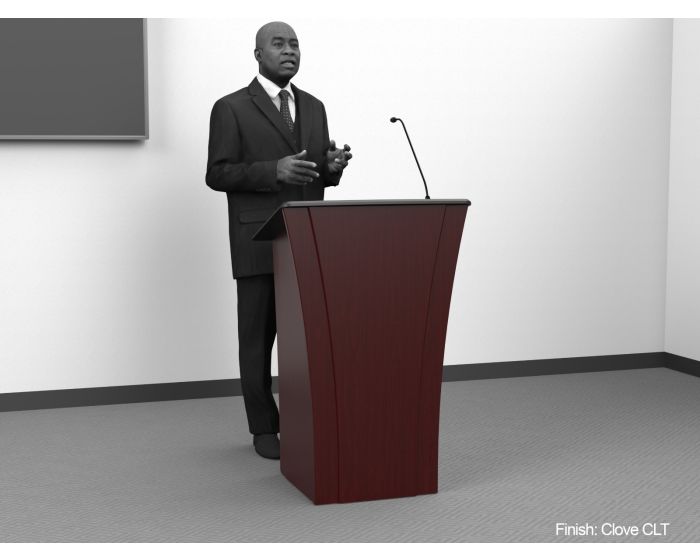
A well-outfitted corporate training room pairs a presenter station sized to the trainer’s tech load with modular tables that reconfigure for different session formats, plus a compact AV-ready package for breakout work.
Corporate training is not a cheap line item, and the number keeps moving. ATD’s 2026 State of the Industry report puts average direct learning expenditure at $846 per employee in 2025, with organizations logging 16.7 formal learning hours per employee (up from 13.7 hours the year before) — www.td.org. Spend less per person, get more hours out of them: that’s the trend right now, which makes the room where those hours actually happen matter more, not less.
A well-designed training room lets instructors present with confidence and lets participants actually engage. A poorly designed one creates friction at every turn: cables that need untangling before a session starts, a lectern that puts the trainer in the wrong spot relative to the screen, tables that can’t reconfigure for the afternoon’s workshop.
Explore AVFI Corporate Training Room Solutions
In short: a corporate training room needs three things to function well: a presenter station that fits the trainer’s actual tech setup, tables that can reconfigure between presentation and workshop formats without a full room teardown, and, increasingly, a separate huddle room package for breakout sessions. Skipping cable-management planning or specifying consumer-grade furniture are the two mistakes that cause the most regret later.
What Does a Corporate Training Room Actually Need From Its Furniture?
At minimum: a presenter station that supports a full AV setup without cable chaos, tables that can shift between lecture-style and workshop formats, and enough flexibility to handle rotating trainers, hybrid attendees, and breakout groups, happening often in the same afternoon. Everything else is refinement on top of that baseline.
Why Does the Presenter Station Deserve This Much Attention?
The presenter station is the operational center of the room; everything else is oriented around it, and a bad one drags down every session held in the space, not just one. Corporate training rooms typically need a station that reads as professional, supports a full technology load, lets the trainer move within a defined area without abandoning their laptop mid-sentence, and works for rotating trainers of different heights and different comfort levels with the tech.
For client-facing or executive briefing spaces: the Executive Lectern (LEX32) pairs clean, professional styling with integrated technology support, worth the aesthetic premium if the room doubles as a space clients or executives walk into.
For trainers running multiple simultaneous inputs: laptop, a second display for notes or remote-participant management, a mic, a video conferencing feed, a standard-width lectern forces compromises. The Wide Multimedia Lectern (LEX36) gives that setup room to breathe, with a pocket-door design that keeps equipment secure and the front face clean mid-session.
Do You Really Need a Height-Adjustable Lectern?
If more than one person trains in the room, probably yes. Corporate training rooms are rarely a single trainer’s domain; L&D staff, outside facilitators, and guest presenters typically share the same station, and a fixed height that works for one person can create real ergonomic strain for the next. A 2022 cluster-randomized trial published in Applied Ergonomics found that adjusting workstation configuration measurably reduced postural exposure and perceived discomfort among office workers; a finding that applies just as directly to someone standing at a lectern for three hours as it does to someone sitting at a desk.
Height-adjustable lecterns also support ADA compliance for presenters using wheelchairs or presenting seated, since the U.S. Access Board’s work-surface standard (28”–34”) is easier to meet with adjustment built in than retrofitted later.
Two options to consider: the Height Adjustable Ergonomic Lectern (LEL023), engineered for a wide height range with smooth adjustment, and the Height Adjustable Lectern (LEX28), a solid general-purpose option for rooms with multiple regular presenters.
What’s the Difference Between a Classroom Setup and a Real Collaboration Space?
Mostly the tables. Table configuration determines how participants interact with the content, the trainer, and each other… and it’s not a minor detail.
Here’s a correction worth making, because it’s a commonly repeated claim: research on open floor plans has actually found the opposite of what you’d expect: Harvard Business School’s Ethan Bernstein and Stephen Turban found that switching two Fortune 500 companies to fully open layouts reduced face-to-face interaction by roughly 70%, as employees retreated to email and messaging instead. The lesson isn’t “open is bad”, but it’s that openness and reconfigurability are two different things, and it’s reconfigurability, not exposure, that actually supports different training formats. A room doesn’t need to feel exposed to be flexible; it needs furniture that can move.
Corporate training rooms need tables that support presentation-style delivery, workshop activities, group exercises, and breakout discussion, ideally without a full room reset between each one.
Video conferencing is now table-stakes, not a bonus feature. That means power access built into the table (not extension cords crossing the floor), cable management for laptops, and layouts where every seat has a clear line to the shared display. The Modular VC Table (T3600 Series) and the Modular VC/Collab Table (T526 Series) both scale from a small workshop group to a full-room session without swapping furniture.
What About Breakout Sessions and Smaller Group Work?
Training programs increasingly build in breakout sessions, small-group exercises, and peer work that happens in adjacent or satellite rooms, and outfitting each of those separately, room by room, gets expensive and inconsistent fast.
A dedicated huddle room package solves that by standardizing the setup: AV-compatible, compact, and consistent no matter which room it lands in. AVFI’s Mobile Huddle Room Package (T47HR) is built for exactly this… a complete, professionally finished table package sized for small-group collaboration spaces.
Which Furniture Fits Which Room Size?
| Room Type | Primary Need | Recommended Furniture |
|---|---|---|
| Small training room (up to 12) | Compact presenter station + table | LEX32 or LEX28 + T526 series |
| Mid-size room (12–30) | Full multimedia lectern + modular tables | LEX36 + T3600 series |
| Large room (30+) | Height-adjustable lectern + scalable layout | LEL023 + modular T3600 config |
| Huddle / breakout space | Compact AV-ready table package | T47HR Huddle Room Package |
What Do Corporate Buyers Get Wrong Most Often?
A handful of furniture decisions consistently underperform expectations, and they’re worth calling out directly:
- Specifying consumer-grade furniture for institutional use. Training rooms see more daily wear than most offices ever will. Consumer-grade surfaces and hardware degrade fast under that kind of traffic. Commercial-grade construction isn’t overkill here, it’s the minimum.
- Treating cable management as a punch-list item instead of a design decision. By the time installation is done, it’s too late to fix cleanly. Tables, lecterns, and floor boxes need to be specified together, as one system, from the start.
- Choosing fixed configurations for rooms that host multiple session types. A room that runs presentations one day and workshops the next needs furniture that adapts, fixed setups that work for one format create friction for every other one.
- Underestimating how much the presenter station affects the actual training. A trainer who spends the first ten minutes wrestling cables or adjusting an uncomfortable lectern isn’t delivering their best session. That’s not a furniture problem in the abstract. It’s a training-quality problem with a furniture-shaped root cause.
Outfitting a Room That Actually Works for Every Session
A corporate training room is an investment in the effectiveness of every program run inside it, and the furniture is what decides whether that investment pays off or gets fought against.
AVFI builds podiums, lecterns, and training room furniture for corporate environments across the United States, with the AV integration, multi-trainer flexibility, ADA compliance, and commercial-grade durability that institutional use actually requires.
Explore AVFI Corporate Training Room Solutions:
- Executive Lectern (LEX32)
- Wide Multimedia Lectern (LEX36)
- Height Adjustable Ergonomic Lectern (LEL023)
- Height Adjustable Lectern (LEX28)
- Modular VC Table (T3600 Series)
- Modular VC/Collab Table (T526 Series)
- Mobile Huddle Room Package (T47HR)
Browse the full AVFI product collection
Planning a training room build-out or renovation? Contact the AVFI team for a walkthrough based on your actual room, not a generic spec sheet.
Training Room Questions We Hear Most
How many people should a training room seat for group work to actually function?
There’s no single number, but most facilitators find groups of 4–6 per table work best for discussion-based exercises. A room sized for 20–30 should plan tables in clusters, not long rows, if workshop formats are part of the mix.
What’s the real difference between a training table and a standard conference table?
Training tables are usually modular and reconfigurable, built to be pushed together, split apart, or angled for different formats. Conference tables are typically fixed, single-piece units built for one consistent layout: a boardroom, not a workshop.
Do I need a separate huddle room, or can breakouts just happen in the main room?
Breakouts can happen in the main room if it’s large enough and the tables are modular, but a dedicated huddle space avoids the noise and logistics problem of running multiple small-group conversations in one open room at once.
Roughly what does it cost to furnish a mid-size training room?
It varies widely by finish level and AV integration, but a mid-size room (12–30 people) typically needs one multimedia lectern and several modular tables. Contact AVFI for a quote based on your room’s actual dimensions and equipment list.
Can training room furniture be reconfigured without hiring a vendor each time?
Yes, if it’s specified that way from the start. Modular tables and mobile lecterns are designed for facilities staff to reconfigure between sessions. The mistake is buying fixed furniture and then wishing it were modular later.
Does hybrid training actually require different furniture than in-person-only training?
Somewhat. Hybrid sessions need power and cable management built into the tables (not extension cords), plus camera and display positioning that gives remote participants a usable view — a video conferencing table isn’t just a table with a webcam bolted on.
Sources: Association for Talent Development, 2026 State of the Industry Report; U.S. Access Board, ADA Standards for Accessible Design, Chapter 9 (§902.3); Applied Ergonomics, “Effects of workstation adjustment to reduce postural exposure and perceived discomfort among office workers” (2022); Harvard Business Review, “The Truth About Open Offices” (Bernstein & Waber, 2019).