
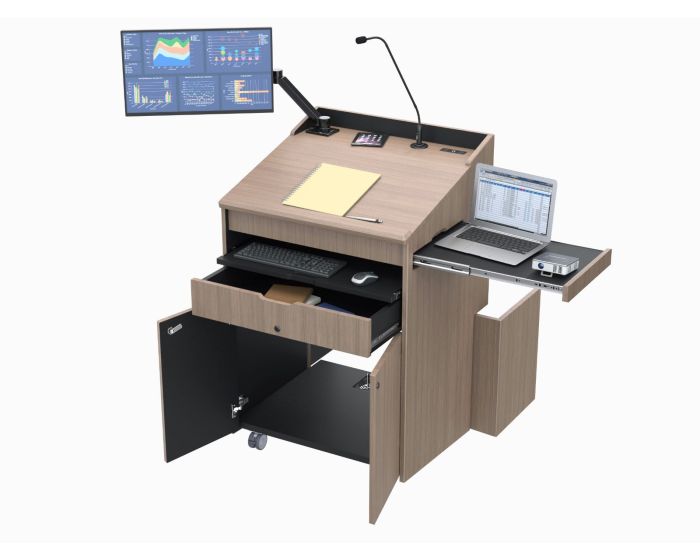
In most people's perception, the core teaching fixture at the front of a traditional classroom is a teacher's lectern used simply to hold lesson materials. However, the role and functionality of this fixture have evolved significantly over the past decade. Today's integrated podiums must accommodate laptops, document cameras, microphones, audio-visual systems, and support both live-streamed and recorded teaching functions.
According to official data released by the U.S. National Center for Education Statistics, the United States has a total of 130,000 K-12 schools and more than 6,000 institutions of higher education, serving over 76 million students. To support such a large-scale education system, educational furniture must be upgraded in sync with the iteration of teaching models.
This guide covers the key purchasing considerations for teachers' podiums, presentation lecterns, and classroom furniture for use in educational settings, as well as compatible products from the AVFI brand.
Explore AVFI solutions for educational spaces: Explore AVFI Educational Furniture Solutions
Why Classroom Furniture Decisions Have Gotten More Complex
Three major transformations are currently shaping in the education sector: technology integration, active learning, and hybrid learning. The fixed-height podiums in traditional lecture halls can no longer meet the new functional requirements for educational furniture.
Long-term records maintained by the American Society for Engineering Education and other similar organizations consistently show that physical learning environments are strongly correlated with educational outcomes. Appropriately adapted instructional furniture can help teachers save time spent adjusting teaching spaces and increase the total duration of interactions between teachers and students.
This study proposes that all K-12 school districts and universities must follow 3 core standards when selecting classroom furniture: durability and wear resistance, compliance with ADA accessibility requirements, and compatibility with all types of teaching models, which establishes universal guidelines for educational procurement.
Key Features to Look For in Educational Podiums and Lecterns
There is no unified standard for classroom requirements that applies to all usage scenarios. University lecture halls that seat 200 people, K-12 computer labs, and graduate seminar rooms each have distinct needs, yet high-quality presenter stations across all these educational stages share common core characteristics.
1. Technology Integration and Cable Management
Today, lecturers need to operate multiple digital teaching tools such as laptops and tablets. If a classroom podium lacks core configurations, including wiring, power supply, and storage, it will give rise to temporary remedial workarounds, which not only delay lecture progress but also disrupt the teaching space.
The four basic mandatory hardware requirements for technology-enabled educational environments include built-in cable management channels, lockable storage compartments, AV hardware rack spaces, and easily accessible power supply pathways.
Example AVFI Solution: The Educational Multimedia Lectern (LEX230) is purpose-built for classroom environments. It supports integrated AV equipment, cable management, and presentation technology, keeping the instructor's workspace organized and professional.
2. Height Adjustability for Multi-Instructor Environments
In teaching sites shared by multiple lecturers, such as lecture halls, shared classrooms, and practical training labs, fixed-height podiums carry ergonomic and accessibility risks. Height-adjustable podiums can adapt to the physical needs of different lecturers and reduce fatigue caused by long hours of teaching.
Existing research published in the journal Ergonomics has found that height-adjustable workstations can reduce musculoskeletal discomfort among workers who perform their jobs while standing. This conclusion can be directly applied to lecturers who spend several hours daily standing at a podium to teach.
Example AVFI Solution: The Height Adjustable Instructor Podium (PDYZ38) provides electric height adjustment for instructors of varying heights and physical requirements. It is designed specifically for classroom environments with multiple daily users.
3. Mobility for Flexible and Multi-Use Classrooms
Currently, most classrooms host a wide range of teaching activities for multiple subjects and grade levels within a single day, leading to prominent pressure on space reuse. Mobile, stowable teacher workstations allow facility managers and frontline teachers to flexibly adapt to all types of teaching scenarios without needing to replace their existing furniture.
On university campuses, when a single classroom hosts three types of teaching activities in one day, mobile podiums fitted with lockable casters offer significant practical value.
Example AVFI Solution: The Mobile Instructor Station (PD51) is a fully equipped mobile presenter station designed for classrooms and training rooms. It includes integrated technology support, cable management, and heavy-duty casters for easy repositioning.
4. Durability for High-Traffic Educational Settings
Furniture used in all educational settings must withstand continuous, demanding usage loads. On university campuses, the average daily usage of this furniture exceeds 9 hours, and K-12 campuses face significantly greater pressure from usage-related wear and tear.
Therefore, material selection is critically important in high-traffic educational environments: commercial-grade laminate is more scratch-resistant and corrosion-resistant than consumer-grade alternatives, steel structures reliably sustain long-term loads, and locked storage can protect equipment used across different time periods.
Example AVFI Solution: The Educational Flat Top Lectern (EDU-LE) is designed for durability in high-use educational environments. Its flat-top surface accommodates a wide range of presentation configurations, and its construction is built to last across years of institutional use.
5. Accessible and Inclusive Design
All public educational institutions in the United States must comply with relevant provisions of the ADA. Compliant podiums or lecterns must accommodate the usage needs of faculty and students with disabilities; they are classified as mandatory accessibility facilities that must be provided for all types of teaching settings on campus, and may not be arbitrarily exempted from deployment requirements or replaced in violation of relevant regulations.
In accordance with the ADA Standards for Accessible Design published by the U.S. Access Board of the United States, adjustable worktables that meet regulatory requirements for vertical headroom clearance are the optimal adaptation solution for educational settings.
Example AVFI Solution: The Educational Workstation (EWS10) supports inclusive educational design with a workstation configuration that accommodates technology needs, accessibility requirements, and the daily demands of classroom instruction.
Matching Furniture to Educational Environment
Furniture requirements for different learning environments within the same institution vary widely, and this paper will organize the furniture selection logic by space.
K–12 Classrooms
For the selection of furniture and equipment for K-12 primary and secondary school classrooms, the core principles are flexibility and durability. These principles are set because the facilities must adapt to the different teaching needs of multiple disciplines and multiple teachers, and cannot be replaced on a frequent basis. The core selection indicators include movable instructional lecterns, upgradeable technical equipment, and wear-resistant work surfaces.
For K-12 education settings, mobile teaching stations and flat podiums, which enable orderly equipment organization and do not require large-scale technical deployment, are the optimally suited options.
University Lecture Halls
The lectern for large tiered lecture halls must meet technical requirements for visibility, compatibility with complex audio-visual setups, and adaptability to the varying heights of different teaching staff. The standard configuration is a height-adjustable multimedia lectern equipped with an integrated equipment rack.
The 2023 Student Technology Report, published by educational technology organization EDUCAUSE, shows that 89% of surveyed students stated that in-class technology affects their learning experience, and podium equipment impacts the user experience of everyone in the classroom.
University Training Labs and Seminar Rooms
The station for small-scale teaching spaces must balance low space footprint and full technical integration, with available options including compact multimedia podiums or idle, repositionable mobile host stations.
Distance Learning and Broadcast Classrooms
Classrooms equipped with recording or live-streaming functions require a main podium that meets the following criteria: it must appear neat when captured on camera, support access to audio and video equipment, and cater to both in-person and online audiences. These classrooms must also be equipped with a dedicated, tidy podium that integrates relevant supporting technologies.
Example AVFI Solution: The Podium with Rack Mount (PD5103) supports dual-audience instruction with rack mount capability for AV processors, amplifiers, and video conferencing hardware, keeping all broadcast-related equipment organized at the presenter station.
What Educational Buyers Often Overlook
Furniture procurement for educational settings often underestimates various practical factors. When purchasing audiovisual equipment for classroom podiums, all procurement activities must center on the unique requirements of educational scenarios, with end-to-end risks mitigated across four core dimensions:
- Delivery process: Select vendors with reliable North American supply chains, align procurement timelines with the academic year procurement window, and avoid installation delays that misalign with semester schedules.
- Maintenance services: Require vendors to support component-level repairability to avoid incurring full replacement costs after a device failure.
- Cabling planning: Develop an integrated plan for all audiovisual (AV) infrastructure covering both the podium and the entire classroom space.
- Compliance requirements: For procurement by public educational institutions, clarify requirements for ADA compliance documentation in advance.
Building Educational Environments That Support Every Instructor
Furniture procurement decisions in educational contexts produce far-reaching long-term impacts. A properly selected podium can adapt to various types of teaching adjustments, while a poorly chosen one will continuously bring inconvenience to its users.
AVFI, an educational furniture manufacturer, produces podiums, lecture stands and classroom furniture, and serves educational institutions across the United States and Canada. Its service coverage spans K-12 school districts to research universities, and its products comply with four major design standards, including ADA compliance.
Explore AVFI Educational Podium and Lectern Solutions:
- Educational Multimedia Lectern (LEX230)
- Educational Flat Top Lectern (EDU-LE)
- Mobile Instructor Station (PD51)
- Height Adjustable Instructor Podium (PDYZ38)
- Educational Workstation (EWS10)
- Podium with Rack Mount (PD5103)
Browse the full AVFI product collection: Products
Need help specifying the right solution for your campus or district? Contact the AVFI team for personalized guidance.
Sources: National Center for Education Statistics (NCES), Digest of Education Statistics, 2023; Ergonomics (journal), workstation height and musculoskeletal outcomes research; EDUCAUSE 2023 Student Technology Report; U.S. Access Board, ADA Standards for Accessible Design.