
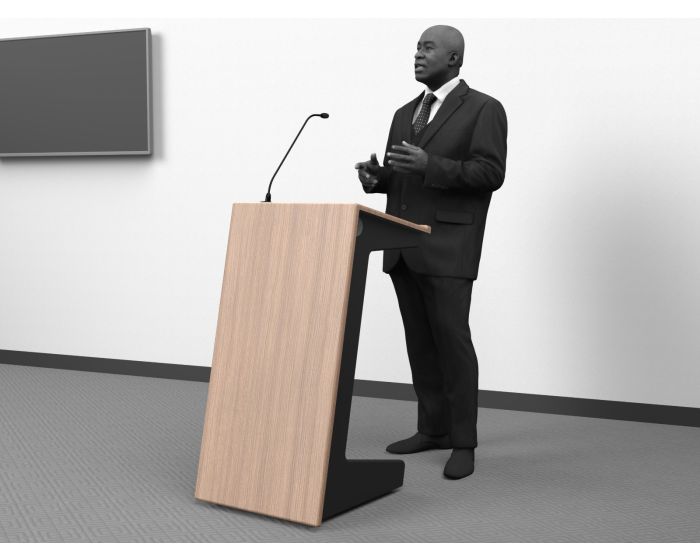
While mobile podiums work best for multi-use rooms and rotating presenters, fixed podiums suit dedicated, formal spaces where the setup never changes, and height-adjustable models often solve both problems at once.
Ask 5 facilities managers whether a presenter station should be mobile or fixed, and you’ll usually get 5 different answers. Why? Because the honest answer is: “it depends on the room,” not “it depends on the trend.” Neither mobile nor fixed presenter stations are universally better; each one wins in a specific context, and this article walks you through all the details you need to know.
In fact, deciding on the specs of the podium might sound inconsequential, but in practice, it touches room design, AV integration, ADA compliance, and how the space will function five years from now, not just on day one.
Explore AVFI Podiums and Lecterns
In short: mobile podiums fit multi-use rooms, shared facilities, and classrooms where the setup changes often. Fixed podiums suit boardrooms, lecture halls, and courtrooms where a consistent, formal presence matters more than flexibility. Height-adjustable lecterns bridge the two, especially where ADA compliance or multiple daily presenters are a factor. Most facilities end up using a mix of all three rather than standardizing on one.
First Thing to Know: What’s the Difference Between a Podium and a Lectern?
Technically, a podium is a raised platform a speaker stands on, and a lectern is the stand holding their notes and equipment. In everyday usage in the U.S., “podium” gets applied to both, which is why AVFI uses both terms here. Buyers search for “podium,” so that’s the word we use even when “lectern” is more precise.
Browse AVFI podiums and lecterns directly if you already know which format you need.
When Should You Choose a Mobile Podium or Lectern?
A mobile presenter station (meaning, one on locking casters that can be repositioned or stored) earns its keep when a room needs to do more than one thing. According to IFMA’s 2024 Space Planning Benchmark Report, over half of organizations (53%) have implemented flexible workspace strategies, up from 38% in 2020; a jump that aligns with how many training rooms, conference centers, and classrooms now get reconfigured multiple times a week. A fixed station in that kind of room becomes a permanent constraint.
In summary, mobile makes sense when:
- The room serves double duty. Presentations Monday, workshop activities Friday. A mobile station can be positioned for the format of the day or wheeled to the perimeter when it’s not needed at all.
- Multiple departments share the space. University buildings, conference centers, and government training facilities that host different tenants throughout the week need a presenter station that isn’t tied to one group’s specific needs.
- Teaching formats vary by class. K–12 and higher-ed instructors often want to reposition the technology to fit the day’s lesson instead of being restrained by a fixed setup.
- The building itself is still changing. Renovations and growth are an ongoing argument against locking in a room layout before the final configuration is set.
Worth considering: the Modern Mobile Lectern (LEX72) brings clean, contemporary styling to spaces that need to move without looking improvised. For classrooms and training rooms specifically, the Mobile Instructor Station (PD51) is built to carry laptops, mics, and AV peripherals on locking casters. And for hybrid and video conferencing setups, the Mobile Telepresence Stand (TP1000 Series) positions cameras and displays at the right height for natural sightlines with remote participants.
Here’s the honest compromise nobody puts in the spec sheet: mobile units may ask for more of your maintenance team. Locking casters need to actually lock (a station that drifts an inch while someone’s mid-presentation is both a safety issue and an embarrassing one). If your facilities team is already overloaded, that’s worth weighing before you standardize on mobile everywhere. Cable management gets trickier too; connections to displays, mics, and recording gear need enough slack to reach the unit wherever it lands, without turning into a trip hazard. Wireless connectivity, where it’s an option, takes most of that headache away.
When Does a Fixed Podium Make More Sense?
A fixed presenter station is the right call when the room has one defined purpose and the presenter’s position never needs to shift. Fixed installations are more stable, tend to support heavier equipment integration, and read as more established, and this matters in boardrooms, council chambers, lecture halls, and houses of worship, where permanence is part of the room’s identity, not just a furniture choice.
Fixed tends to win when:
- It’s a dedicated boardroom or executive space. A fixed lectern that’s visually integrated with the room reads very differently from a mobile unit that looks like it was wheeled in for the occasion.
- The room has permanent AV built around one position. Large lecture halls with fixed displays, ceiling mics, and recording systems are built around a single presenter location. A fixed lectern aligned to that infrastructure will simply outperform a mobile one here.
- It’s a house of worship. Traditional worship spaces usually want a lectern that reads as part of the architecture, with a stable presence and enough surface area for books, notes, and more than one presenter.
- It’s a courtroom or council chamber. These formal public settings need a presenter station that doesn’t move between sessions, supporting the procedural consistency the space is built around.
For boardrooms and executive briefing spaces, the Executive Lectern (LEX32) pairs clean styling with integrated tech support. If a trainer or presenter runs multiple simultaneous inputs—laptop, second display, mic, video conferencing—the Wide Multimedia Lectern (LEX36) gives them the surface area and cable management to do that without improvising.
What About Height-Adjustable Lecterns?
Height-adjustable stations are the category that often makes the mobile-vs-fixed debate moot. They stay in one place like a fixed unit but adjust, electrically or manually, to fit a wide range of presenter heights and physical needs. Some models add mobility on top of that adjustability, giving you both a stable working position and the option to move it later.
Why does this matter more than it might seem? Under the ADA Standards for Accessible Design, work surfaces must fall between 28 and 34 inches above the finish floor to meet accessibility requirements (a range that no single fixed height can serve for every presenter). Height-adjustable lecterns meet that standard as a baseline design feature, not a retrofit. That’s a meaningful distinction if your facility has multiple daily presenters, a legal obligation to accommodate wheelchair users or presenters who work seated, or both.
Two models worth a look: the Height Adjustable Lectern (LEX28) for general multi-presenter environments, and the Height Adjustable Instructor Podium (PDYZ38), built specifically for classrooms with electric adjustment that doesn’t ask instructors to fight with manual cranks between periods.
How Do You Decide Between Mobile, Fixed, and Adjustable?
The table below is a starting point for you to save:
| Consideration | Mobile | Fixed | Height-Adjustable |
|---|---|---|---|
| Room serves multiple purposes | Best fit | Not ideal | Good fit |
| Single, dedicated use | Works | Best fit | Works |
| Multiple presenters daily | Good fit | Acceptable | Best fit |
| ADA compliance required | Possible with the right model | Depends on the model | Best fit |
| Executive / boardroom aesthetics | Acceptable | Best fit | Good fit |
| Budget priority | Mid-range | Lower cost | Higher cost |
| Equipment needs frequent updates | Best fit | Manageable | Good fit |
Can You Combine Mobile and Fixed Stations in the Same Space?
Often, yes.
And larger or more complex spaces frequently do. A university lecture hall might keep a fixed multimedia lectern as its primary station while adding a mobile AV cart that moves between rooms. A corporate conference center might run fixed executive lecterns in its boardrooms and mobile instructor stations in its training rooms next door. That’s a more deliberate approach than specifying the same furniture everywhere regardless of how each room actually gets used, and it tends to age better as needs shift.
If your facility already leans this direction, the Multimedia AV Cart (103324) is a common complement to a fixed lectern, giving secondary or overflow presentation spots their own mobile technology platform without touching the main station.
Making the Right Call for Your Space
This isn’t a question of which format is objectively better. It’s a question of what your space needs to do, and how often it needs to do it. Multi-use rooms lean mobile. Dedicated, formal spaces lean fixed. Rooms with rotating presenters or ADA obligations lean height-adjustable. And plenty of buildings end up using all three, in different rooms, for different reasons, and this is usually the sign of a facility plan that was actually thought through rather than templated.
AVFI builds podiums, lecterns, and presenter stations across mobile, fixed, and height-adjustable configurations for educational, corporate, government, and event environments, with the AV integration, ADA compliance, and durability that day-in, day-out institutional use demands.
Explore AVFI Mobile, Fixed, and Adjustable Solutions:
- Modern Mobile Lectern (LEX72)
- Mobile Instructor Station (PD51)
- Executive Lectern (LEX32) — Fixed
- Height Adjustable Lectern (LEX28)
- Height Adjustable Instructor Podium (PDYZ38)
- Mobile Telepresence Stand (TP1000 Series)
Browse the full AVFI podium and lectern collection
Not sure which configuration fits your space? Contact the AVFI team for a walkthrough of your room and a recommendation you can actually take to a purchase order… not just a brochure.
Podium and Lectern: Questions We Hear Most
Is a podium the same thing as a lectern?
Not technically. A podium is a raised platform a speaker stands on; a lectern is the stand holding their notes and equipment. Most people say “podium” when they mean “lectern,” and AVFI uses both terms so buyers can find what they’re actually looking for.
Can a mobile lectern be locked in place during a session so it doesn’t shift?
Yes, that’s what locking casters are for. The quality of the locking mechanism varies a lot between models, though, so check load rating and lock engagement before specifying a mobile unit for daily, high-traffic use.
Do height-adjustable lecterns automatically meet ADA requirements?
They meet the baseline work-surface height range (28”–34”) specified in the ADA Standards for Accessible Design as a design feature, not a modification. That said, full compliance also depends on clear floor space and approach, so it’s worth confirming the whole installation, not just the lectern itself.
How much more does a fixed lectern cost compared to a mobile one?
It typically runs the other way: fixed units tend to be the lower-cost option, since they don’t need caster hardware or locking mechanisms. Height-adjustable models, particularly electric ones, usually sit at the top of the price range.
Do mobile units wear out faster than fixed ones?
Not the frame or surface, but casters and locking hardware are moving parts, and moving parts need maintenance. A well-built mobile lectern in a well-maintained facility can last just as long as a fixed one; a neglected caster system is usually what shortens the lifespan.
Can I add wheels to a fixed lectern later if my needs change?
Sometimes, but it’s not a given. It depends on the base design and whether the manufacturer offers a retrofit kit. It’s usually cheaper and more reliable to specify mobility upfront if there’s a real chance you’ll need it.
Sources: IFMA, 2024 Space Planning Benchmark Report; U.S. Access Board, ADA Standards for Accessible Design, Chapter 9 (§902.3); Applied Ergonomics, “Effects of workstation adjustment to reduce postural exposure and perceived discomfort among office workers” (2022).